



“I will not teach or love or show you anything perfectly, but I will let you see me, and I will always hold sacred the gift of seeing you—truly, deeply, seeing you.” ~Brené Brown
The first time my kids saw me truly cry was Christmas of 2021. My oldest was sixteen, and my youngest was twelve.
They had just opened their presents. It should have been a warm, joyful morning. Instead, I turned away toward the foyer near the entry of the house, my back to them, as tears threatened to spill over. My mom—whose emotional chaos had disrupted a large part of my life—was in a psychiatric hospital again. Her mental health had unraveled once more, and the grief of it all, the repetition, the helplessness, finally caught up with me.
I had spent years trying to keep my pain out of sight. I thought I could hide it again. But this time, I couldn’t.
Both of my children asked, “Are you okay?”
I whispered, “I’m fine,” even as the tears streamed down.
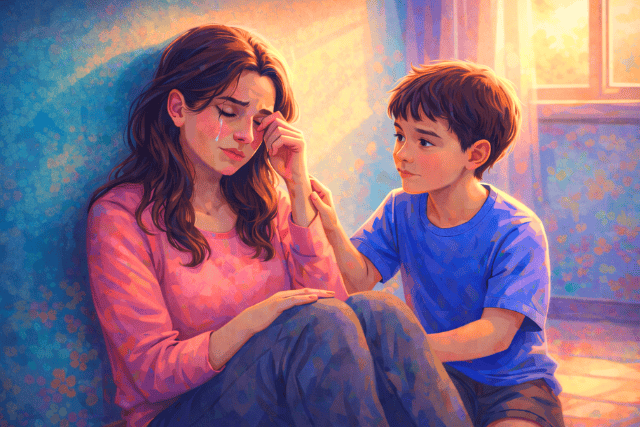
Then something unexpected happened. They both came toward me and wrapped me in a hug. No fear. No confusion. Just love. Pure and steady.
That moment began to unravel something in me. What met me was tenderness. My children were not overwhelmed by my sadness. They simply responded to it. In that moment, something old began to crack: the belief that my pain was dangerous to the people I loved most.
I had spent so long trying not to become like my mom. I always felt responsible for her feelings and well-being, and I never wanted my own children to feel burdened the way I had. But in trying so hard not to repeat the past, I held my emotional interior very guarded when I was sad.
I thought I was protecting them.
What I didn’t understand then was that my children did not need protection from my humanity. They needed some connection to it.
In late 2023, my younger child made an observation that showed me my hiding wasn’t really working.
“You’re the sad one,” he said, “and Dad is the mad one.”
The truth stung, but I knew he wasn’t being cruel. He was simply saying what he saw.
And he wasn’t wrong.
After that Christmas, I had gone back to holding everything in and trying not to let too much of my sadness show. But even without tears, my son had still been seeing my sadness for years—through what was happening with my mom, through losses I had carried quietly, through burdens I thought I was keeping to myself.
Of course he sensed it. Maybe it was in my demeanor or my energy, in the heaviness on my face, in the way I sometimes stared off blankly, or in the moments when he had to call my name several times before I came back. He often asked, “Are you okay, Mommy?” He knew something was there.
That was the moment I realized there was no point in hiding my inner world if my children could already feel it without words.
Kids are incredibly intuitive. Even when they don’t have the language, they can feel what is happening. They pick up on tension, sadness, distance, and strain long before anyone explains it. When we pretend everything is fine, they still feel that something is off.
What I began to understand is that without context, they were left to make meaning out of what they felt. They could assume my sadness had something to do with them, or that it was something they needed to fix.
But when I began giving them enough truth—without trauma dumping, without making them carry what was mine—they were better able not to personalize what they were sensing. They could understand that I had feelings, that those feelings were real and human, and that those feelings were not their fault.
I also began to see something else more clearly: my children had always seen me as strong, independent, and capable, the one who managed things and handled what needed to be handled. Because I did not let them see what I perceived as weak, I never really gave them the chance to know this too: I have feelings. My feelings matter too. Not just theirs.
As I began sharing more of my interior world in age-appropriate ways, my children became more thoughtful and considerate. Not because they were responsible for me, but because they could understand me more fully.
What hit me hardest was realizing that the very thing I had felt as a child—being unseen—was something I was repeating with my own kids without even knowing it. Not in the same form, but in a similar emotional pattern.
How could they really see me if I never let them know anything about what was happening inside me? How could we have true connection if I only let them relate to my strength, competence, and composure while hiding the deeper parts of my inner world?
By 2026, something had begun to change, but not quickly and not by accident. It came after years of therapy, reflection, and slowly learning how often I still suppressed what I felt—pushing it down, swallowing hard, going into my bedroom to hide it, trying to regain composure before anyone saw. Little by little, I stopped doing that as much. I cried more freely. I let more be seen.
My youngest son, who is autistic and deeply bonded to me, at first didn’t know what to do when I began letting my tears show more often. A few months ago, while I was crying, he said, “I want to make you feel better, but I don’t know how.”
I told him, “You don’t have to fix anything. Just let me be me, and I’ll let you be you. That’s the best gift we can give each other.”
After that, I sensed his awkwardness begin to soften into acceptance.
A little later, as we were landing in Houston after a trip to Canada, tears started falling again. I didn’t want to come back. That place no longer feels like home to me. Without saying a word, my son wrapped his arms around me and held me while I cried.
After a few minutes, I exhaled and said, “Thank you. I feel better now.”
But it was the moment in the car that stayed with me most.
About a month later, I was crying again while we were driving. A song came on the radio that reminded me of someone I missed, and the sadness rose up fast. He was sitting next to me, and I said, “I’m okay, honey. The song just reminds me of someone and makes me sad. I just need to get it out, and then I’ll be okay.”
Even then, I still felt self-conscious. Some part of me still worried he might be judging me.
Instead, he said something that completely stunned me.
“I wish I could cry like that,” he said. “You’re strong.”
I laughed a little and said, “I get it, honey. We’ll get you crying again eventually.”
I meant it tenderly, but I also realized in that moment that he had learned some of the same lessons so many boys learn early—that tears get pushed down, that feelings get stuck, that crying becomes something to resist. And I knew he had learned some of that from what both his dad and I had modeled. It would take time to unlearn.
That moment stayed with me because it showed me how differently he was seeing my tears than I had always seen them myself.
For so much of my life, I had equated crying with weakness. I thought being strong meant holding everything in, staying composed, pushing through, and keeping the hard parts hidden. But through my son’s eyes, I saw something different. He did not see my tears as failure. He saw courage in them.
That moment opened up another conversation between us. He told me he could not cry anymore. He said it always felt stuck in his throat. He could feel it, but it would not come out. He told me the last time he had really cried was when he was thirteen.
I thought then about how much energy so many of us spend trying not to feel what is already there.
For years, I thought being a good parent meant being unshakable. I thought strength meant keeping my children from seeing my grief, my overwhelm, my tenderness, and my breaking points.
Now I think children need honesty more than performance. They need to know that hard feelings can be felt without becoming dangerous, that sadness can move through a room without becoming their responsibility, and that love does not disappear when life gets hard.
I used to think my tears would make my children feel less safe.
What I know now is that when those tears are held with honesty and care, they can teach something powerful: that being fully human is not weakness, and connection often deepens the moment we stop pretending we have nothing to feel.

About Allison Briggs
Allison Jeanette Briggs is a therapist, writer, and speaker specializing in helping women heal from codependency, childhood trauma, and emotional neglect. She blends psychological insight with spiritual depth to guide clients and readers toward self-trust, boundaries, and authentic connection. Allison is the author of the upcoming memoir On Being Real: Healing the Codependent Heart of a Woman and shares reflections on healing, resilience, and inner freedom at on-being-real.com.
