



Donald Trump’s first term as president saw some of the largest mass protests seen in the U.S. in over 50 years, from the 2017 Women’s March to the 2020 protests after George Floyd’s murder.
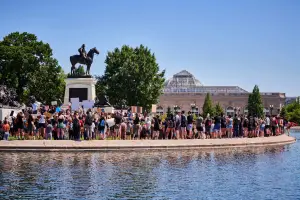
A Black Lives Matter protest in Washington, D.C., in May 2020 (Geoff Livingston, CC BY-NC-ND 2.0)
Things feel different this time around. Critics seem quieter. Some point to fear of retribution. But there’s also a sense that the protests of Trump’s first term were ultimately futile. This has contributed to a widespread mood of despair.
As The New York Times noted not long ago, Trump “had not appeared to be swayed by protests, petitions, hashtag campaigns, or other tools of mass dissent.” That’s a common perspective these days.
X

But what if it’s wrong?
As a historian, I study how our narratives about the past shape our actions in the present. In this case, it’s particularly important to get the history right.
In fact, popular resistance in Trump’s first term accomplished more than many observers realize; it’s just that most wins happened outside the spotlight. In my view, the most visible tactics—petitions, hashtags, occasional marches in Washington—had less impact than the quieter work of organizing in communities and workplaces.
Understanding when movements succeeded during Trump’s first term is important for identifying how activists can effectively oppose Trump policy in his second administration.
Quiet victories of the sanctuary movement
Mass deportation has been a cornerstone of Trump’s agenda for more than a decade. Yet despite his early pledge to create a “deportation force” that would expel millions, Trump deported only half as many people in his first term as Barack Obama did in his first term.
Progressive activists were a key reason. By combining decentralized organizing and nationwide resource-sharing, they successfully pushed scores of state and local governments to adopt sanctuary laws that limited cooperation with Immigration and Customs Enforcement, or ICE.
When the sociologist Adam Safer examined thousands of cities and dozens of states, he found that a specific type of sanctuary law that activists supported—barring local jails and prisons from active cooperation with ICE—successfully reduced ICE arrests. A study by legal scholar David K. Hausman confirmed this finding. Notably, Hausman also found that sanctuary policies had “no detectable effect on crime rates,” contrary to what many politicians allege.
Another important influence on state and local officials was employers’ resistance to mass deportation. The E-Verify system requiring employers to verify workers’ legal status went virtually unenforced, since businesses quietly objected to it. As this example suggests, popular resistance to Trump’s agenda was most effective when it exploited tensions between the administration and capitalists.
The “rising tide” against fossil fuels
In his effort to prop up the fossil fuel industry, Trump in his first term withdrew from the Paris climate agreement, weakened or eliminated over 100 environmental protections, and pushed other measures to obstruct the transition to green energy.
Researchers projected that these policies would kill tens of thousands of people in just the United States by 2028, primarily from exposure to air pollutants. Other studies estimated that the increased carbon pollution would contribute to tens of millions of deaths, and untold other suffering, by century’s end.
That’s not the whole story, though. Trump’s first-term energy agenda was partly thwarted by a combination of environmental activism and market forces.
His failure to resuscitate the U.S. coal industry was especially stark. Coal-fired plant capacity declined faster during Trump’s first term than during any four-year period in any country, ever. Some of the same coal barons who celebrated Trump’s victory in 2016 soon went bankrupt.
The most obvious reasons for coal’s decline were the U.S. natural gas boom and the falling cost of renewable energy. But its decline was hastened by the hundreds of local organizations that protested coal projects, filed lawsuits against regulators, and pushed financial institutions to disinvest from the sector. The presence of strong local movements may help explain the regional variation in coal’s fortunes.
Environmentalists also won some important battles against oil and gas pipelines, power plants, and drilling projects. In a surprising number of cases, organizers defeated polluters through a combination of litigation, civil disobedience, and other protests, and by pressuring banks, insurers, and big investors.
In 2018, one pipeline CEO lamented the “rising tide of protests, litigation, and vandalism” facing his industry, saying “the level of intensity has ramped up,” with “more opponents” who are “better organized.”
Green energy also expanded much faster than Trump and his allies would have liked, albeit not fast enough to avert ecological collapse. The U.S. wind energy sector grew more in Trump’s first term than under any other president, while solar capacity more than doubled. Research shows that this progress was due in part to the environmental movement’s organizing, particularly at the state and local levels.
As with immigration, Trump’s energy agenda divided both political and business elites. Some investors became reluctant to keep their money in the sector, and some even subsidized environmental activism. Judges and regulators didn’t always share Trump’s commitment to propping up fossil fuels. These tensions between the White House and business leaders created openings that climate activists could exploit.
Worker victories in unlikely places
Despite Trump self-promoting as a man of the people, his policies hurt workers in numerous ways—from his attack on workers’ rights to his regressive tax policies, which accelerated the upward redistribution of wealth.
Nonetheless, workers’ direct action on the job won meaningful victories. For example, educators across the country organized dozens of major strikes for better pay, more school funding, and even against ICE. Workers in hotels, supermarkets, and other private-sector industries also walked out. Ultimately, more U.S. workers went on strike in 2018 than in any year since 1986.
This happened not just in progressive strongholds but also in conservative states like West Virginia, Oklahoma, and Kentucky. At least 35 of the educators’ strikes defied state laws denying workers the right to strike.
In addition to winning gains for workers, the strike wave apparently also worked against Republicans at election time by increasing political awareness and voter mobilization. The indirect impact on elections is a common side effect of labor militancy and mass protest.
Quiet acts of worker defiance also constrained Trump. The early months of the COVID-19 pandemic featured widespread resistance to policies that raised the risk of infection, particularly the lack of mask mandates.
Safety-conscious workers frequently disobeyed their employers, in ways seldom reflected in official strike data. Many customers steered clear of businesses where people were unmasked. These disruptions, and fears they might escalate, led businesses to lobby government for mask mandates.
This resistance surely saved many lives. With more coordination, it might have forced a decisive reorientation in how government and business responded to the virus.
Labor momentum could continue into Trump’s second term. Low unemployment, strong union finances, and widespread support for unions offer opportunities for the labor movement.
Beyond marches
Progressive movements have no direct influence over Republicans in Washington. However, they have more potential influence over businesses, lower courts, regulators, and state and local politicians.
Of these targets, business ultimately has the most power. Business will usually be able to constrain the administration if its profits are threatened. Trump and Elon Musk may be able to dismantle much of the federal government and ignore court orders, but it’s much harder for them to ignore major economic disruption.
While big marches can raise public consciousness and help activists connect, by themselves they will not block Trump and Musk. For that, the movement will need more disruptive forms of pressure. Building the capacity for that disruption will require sustained organizing in workplaces and communities.
This article is republished from The Conversation under a Creative Commons license. Read the original article.
