



Boys get a lot of messages about masculinity and how to be men. Unfortunately, they often sound like this:
“You act like a girl.”
“Take it like a man.”
“Don’t be a beta.”
“Grow some balls”
“Never let them see you cry.”

Masculinity is often defined by dominance, stoicism, physical strength, and the ability to provide. It has, perhaps, been even more defined by what it is not: soft, sensitive, emotional, feminine, or “queer” in any way. For many men and boys, there is little room to express fear, anxiety, depression, or even tenderness.
X
These expectations are stubbornly persistent, and can be very limiting. Without an outlet for their more complicated emotions, many men deal with stress by drinking or using drugs, sometimes with deadly consequences.
We interviewed more than 80 boys while writing our book Talk to Your Boys: 16 Conversations to Help Tweens and Teens Grow into Confident, Caring Young Men. Over and over again, we heard how much these restrictive messages about masculinity influence their lives, their behavior, and their relationships. Fortunately, we also found that there are ways to talk with boys that will help them to connect with their true selves and with the people around them.
What’s the hardest part of being a boy today?
“Trying to look tough and be masculine. Not being too ‘girly’ or liking ‘weird’ things, like certain TV shows or video games” —Xavier, age 15
“Being expected to provide absolutely everything, and being blamed for stuff without being able to fight back.” —Roberto, age 14
“The inability to share feelings and emotions with peers and trusted adults.” —Nadev, age 15
“Being held to a standard of being strong and not affectionate.” —Carson, age 15
Boys learn early that if they stray too far from “acceptable” behavior, their masculinity may be called into question—sometimes with gentle teasing, sometimes with verbal slurs, sometimes with fists.
This “policing” of masculinity starts young. Research by Judy Y. Chu shows that boys at four and five years old are highly relational and emotionally perceptive. In her book When Boys Become Boys, she writes: “The boys in my study demonstrated a remarkable ability to be astute observers of their own and other people’s emotions, sensitive to the dynamics and innuendos within their relationships, and keenly attuned to norms and patterns within their social interactions and cultural contexts.”
Chu notices a profound shift starting in prekindergarten, when the same boys started to focus more on impressing others than engaging with them, withholding their personal insights and being less direct and authentic with others to preserve their place in their social group. Essentially, they started to assume the traditional cultural code on what it means to “be a man.”
Chu doesn’t think it has to be this way. She writes that the antidote to this change is to foster a culture of relationships that provide different values and information on other ways of being.
As boys get older, she argues, conversations about masculinity may need to change. We also need to recognize different factors that influence what it means to be a man to your boy, among his peers and out in your community.
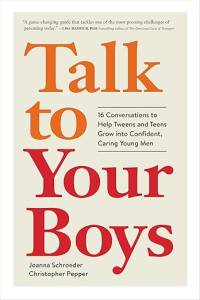
Excerpt adapted from Talk to Your Boys by Joanna Schroeder and Christopher Pepper (Workman Publishing). Copyright © 2025.
“Masculinity comes with a set of perks and pitfalls that are often tangled up with race, age, body type, and other aspects of diversity,” says psychologist and author Donald E. Grant Jr. “These intersections push young men into rigid templates of who they should be,” he told us, “while society practically hands out gold stars for avoiding anything that resembles introspection.”
As parents, we can encourage our boys to resist the confines of this rigid template of masculinity in a wide variety of ways. Grant suggests practices like mindfulness, meditation, and yoga.
He recognizes that for many young men, “those sound about as appealing as voluntarily giving up the remote during a game,” but encourages us to reframe these practices as ways to grow a different type of strength.
“By teaching boys and young men how to flex their critical thinking and emotional intelligence muscles, we disrupt that cycle,” he explained. “We push them to try on new identities, see what fits, and figure out what feels genuine in the moment. It’s a bit like a mental spring cleaning—keeping what resonates, tossing what doesn’t, and coming out with a version of themselves that’s actually their own.”
Conversations about masculinity
According to our experience and the advice of other educators and researchers, you want to be able to talk about masculinity without being too serious or pushy. Pay attention to what your boys are watching, playing, and laughing about and use those interests as a starting point for conversations around masculinity. Here are some examples:
Scenario: You see a dad out and about with young children, without a mom or partner around.
Try saying: “Back when I was your age, a dad out with young kids alone would’ve been considered unusual. People would probably ask if it’s ‘Daddy Babysitting Day,’ as if a dad can babysit his own kids!”
Ask: “Isn’t it weird to think that, for so many years, people thought dads couldn’t take good care of their own little kids?”
Scenario: You see a man wearing a “feminine” color or clothing item on TV or out in the world.
Try saying: “I love that some guys feel comfortable wearing whatever works for them and don’t always have to follow those stuffy old rules from the past.”
Ask: “What do you think?”
Scenario: You see a man crying on TV or even in person, during an emotional moment.
Try saying: “It was very rare for men to publicly cry when I was your age. But holding in emotions is bad for people, and so I’m glad more people understand the power of vulnerability these days—especially from men.”
Ask: “What do you think when you see a guy crying? Would you ever feel like you could cry in public or in front of your friends?”
Scenario: You interact with a man working in what might be considered a “female” career, like a nurse or a kindergarten teacher.
Try saying: “One of the coolest things I’ve seen happen in my lifetime is the way so many careers have opened up to people regardless of gender. There are so many women CEOs now compared to a generation or two ago—and there are also more men taking up nursing.
Ask: “I wonder what sort of benefits there are to having men in caring professions like this?” or “Can you imagine yourself going into a caring profession someday?”
Don’t try to address everything in a single talk—the goal should be to start talking about these topics and keep the lines of communication open. It often can be more effective to have 60 one-minute talks than to have one 60-minute talk.
We want to create a world where boys are comfortable accessing and expressing a full range of emotions, where creating community and helping others is seen as a sign of strength. It’s a change that benefits boys, for sure, but also their friends, their families, their future partners and children, and the world at large. Thankfully, things are changing, and boys are looking for guidance about how to be “real men” while also being their authentic selves.
